
Chronic Wasting Disease: "Zombie Deer" Epidemic Explained
An epidemic of Chronic Wasting Disease among deer is taking hold, with many concerned about the dangers of "Zombie Deer" roaming the forests.

The “zombie deer” disease, officially known as Chronic Wasting Disease (CWD), has come into the public eye recently. Several eyewitness accounts and videos of deer, as well as various other animals infected with said disease, strike no less than a health concern in many.
What Is Chronic Wasting Disease?
CWD is a progressive neurological disease that attacks the brain, spinal cord, and various other tissues. Being distinctive in primarily mule deer, white-tailed deer, elk, and moose, CWD is a type of prion disease. These diseases are found in various animals and examples of such include the well known “mad cow disease”.
Characteristic to this pathogen family, CWD is slow to develop and symptoms may not become evident for long after infection. This is due to its incubation period of no less than a year.
Scientists have narrowed down what that believe to be the main forms of transmission. In general, it appears that CWD is spread through primarily bodily fluids such as saliva, blood, or urine. These fluids leaking into soil, food, and water can have catastrophic effects on the ecosystem by escalating a small, isolated case into an epidemic.
Symptoms of this ultimately fatal disease include:
- Drastic weight loss (hence “wasting”)
- Stumbling
- Lack of coordination
- Listlessness
- Drooling
- Excessive thirst or urination
- Lack of fear towards people
Given that each of these symptoms is associated with many other diseases, it is difficult to diagnose Chronic Wasting Disease based exclusively off of these symptoms. At this time, CWD has not infected domesticated animals.
Effects of CWD Infection
Researchers have found that CWD-positive deer have a fatality rate 3 times higher than their healthy counterparts. Mortality rates were as high as 75% in infected deer in contrast to the 25% seen in those not infected.
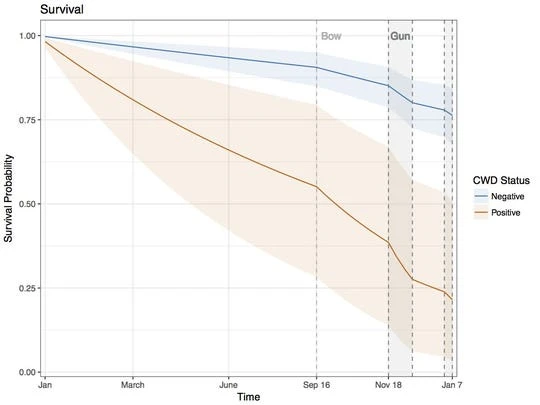
Not only is this virus a potentially serious threat to the ecosystem, but also to the economy. UCA student of economics Makayla Palmer points to the demonstratively negative effects CWD has already had on states. In 2002, Wisconsin lost an estimated $53 million due to a decrease in deer population and in hunting fees. Hunters provide a substantial boost to the state economy as their fees pay for the conservation of lands and parks. Beyond fees, hunters provide millions of dollars to various businesses through their purchase of guns, ammo, clothing, and a myriad of other equipment.
Are Humans Susceptible to CWD?
As according to a POLS research paper, CWD is projected to have a gross negative long term outcome on the deer population as a whole. Moreover, it is quite probable that this terminal infection will transform into a human form. The director of the Center for Infectious Disease Research and Policy at the University of Minnesota, Michael Osterholm, told USA TODAY: “It is probable that human cases of chronic wasting disease associated with consumption with contaminated meat will be documented in the years ahead. It’s possible the number of human cases will be substantial and will not be isolated events.”
Is There a Cure?
The first successful CWD vaccine was approved for testing in late 2014 and even showed promise for a cure to other diseases. This vaccine is part of research to fight Creutzfeldt-Jakob disease, kuru, familial insomnia, and variably protease-sensitive prionopathy.
Frank Bastion is taking the lead in furthering the development of this cure and has made an impressive breakthrough. The neuropathologist has stumbled on a way to home-grow the pathogen, thereby enabling advanced research to be done on demand. Bastion comments, “This is really exciting news because this allows me to work on the bacteria, while other laboratories with access to chronic wasting disease-affected deer tissues can conduct research also”. In light of this, it appears to even the experts that a cure is just around the corner.