Sudan Meal Project and Politicians Betray You the Same Way
Sudan Meal Project turned mass compassion into a follower count — the same con politicians run with your deference.

If we could solve our problems with the click of a button, our internet-crazed world would have done so years ago. Clearly, it’s a lot more complicated than that, but it hasn’t stopped everyone from trying. From sending thoughts to shooting victims to sharing a picture in order to plant a tree, the world has consistently tried to improve itself via social media campaigns. The problem is, a retweet or like requires no work. Unfortunately, global change does.
Sudan Meal Project: The Great Lie
The latest in the long line of social media awareness campaigns is the Sudan Meal Project. For every follow and share they got, the account owners pledged to give one meal to starving children in Sudan (up to 100,000).
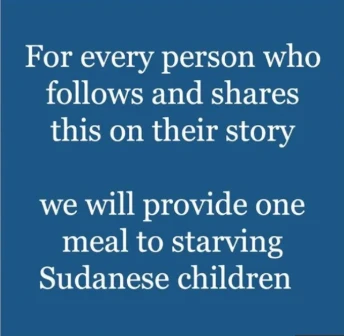
If you’re curious whether or not the Sudanese children got their food or not, ask the kids personally. In your efforts, you’ll probably discover that it is incredibly difficult to make contact. The borders are closed, and those without food certainly don’t have an internet-enabled device. Unless you happen to be well-connected or run an established humanitarian aid NGO, you aren’t making contact with Sudanese children.
Neither is Sudan Meal Project, for the same reasons as you; they have no credentials, no ability to deliver on their promise.
The Meme Scheme Profit Machine
This opens the floor for two important questions: what motive the account owner had and why so many people bought into the lie. The first is fairly simple to answer. A large Instagram page is a valuable asset in our increasingly digital economy. Top meme pages can prove incredibly profitable via sponsored posts, affiliate marketing, and other strategies.
A screenshot of direct messages between the account and an unknown user appears to show a confession of abusing the account for influence. Sudan Meal Project admits to staging the charity in order to amass a large number of followers. Of course, it worked. Though it is impossible to prove the direct messages as legitimate, the account has yet to publicly dispute them, despite circulating heavily.
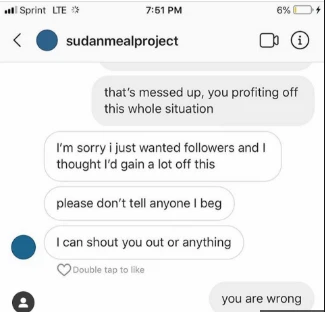
Several days after making it big, Sudan Meal Project suddenly vanished. Their username went blank, which undoubtedly means that the account changed usernames. In all likelihood, they switched usernames, too. Sad as it is to say, Sudan Meal Project probably sold that account to an Instagrammer looking to make money as an influencer. In simpler terms, they’re somebody’s meme account now.
Effort in vs Results Out
So, why is it that they were able to amass such a large following? It ultimately has a lot to do with humanity’s concept of change. When looking at how to improve the world, two axes are important: effort in and results out. Of course, it’s completely rational to want to see the best results while doing the least amount of work to achieve them. If someone can donate $100 by pressing a button compared to working ten hours to earn that money, the button is obviously the preferable option.
If we look at this situation in reality, though, buttons don’t generate $100, just like shares don’t generate meals. Though unfortunate, there is a strong correlation between effort in and results out; not just when it comes to charity, but also to most forms of work in our world. Though there are certainly exceptions, when all else is equal, someone who works harder for something is usually going to get it. On the other hand, someone who hopes somebody else will do the work for them may be sorely disappointed.
Deference: Kicking Away the Can
This hope, that somebody else will solve the world’s problems, is a form of deference: yielding to a perceived authority figure, allowing him or her to take action for you. In the case of Sudan Meal Project, there was no real authority. It makes sense that hundreds of thousands of people deferred to them; to reiterate, the average person has no way of solving the Sudan crisis and may have been looking for any way to help. But deference runs much deeper than this in our culture and the effects can be quite dangerous.
In the case of social media, the results are typically sad, but not legitimately harmful. Whoever is really behind Sudan Meal Project certainly did a disservice, but didn’t actually make the issue any worse. The same people who couldn’t and didn’t help, now can’t and don’t help, but at least think they did. Meanwhile, the children in Sudan are no better but no worse. The government is still forcibly restricting their food supply and millions still fear for their lives.
Likewise, sharing an Instagram post that promises to plant a tree doesn’t really cause direct harm. However, the deference within it can lead to future indirect harms. For example, someone who shares that post may think that he or she has already done their part for the environment. Admittedly, the post could place the thought of environmental consciousness into the person’s head, psychologically priming them for future action.
Strong-Willed Inaction
However, this person may stop short of planting an actual tree, thinking his or her job is already done. If someone believes a tree can be planted by either going outside and planting it or clicking a button, most would choose the latter; it’s simpler and (supposedly) accomplishes the same task.
So, deference can have the unintended consequence of causing personal inaction. When authority figures then fail to deliver their promises, nothing gets done, despite the deferrer thinking he or she made a difference by submitting to someone else. Sadly, this deference, coming in the form of strong-willed inaction, is incredibly common. In fact, it permeates the very structure of our society.
Voting as Deference
When Americans go to the polls in November, they aren’t taking action. In fact, they aren’t really doing much besides hoping.
Pressing a lever doesn’t make your employer pay you any more money; it doesn’t stop the wars from raging overseas; it doesn’t stop cops from annually killing several times more people than mass shooters; certainly, it doesn’t feed the millions of hungry people living in America, in your town, perhaps in your neighborhood. Instead, voting is just another masked form of deference, the “thoughts and prayers” of politics. But in this case, the perceived authority is the candidate that you hope 51% of people also select.
After a vote, it’s easy to go home, satisfied that you played your part to make a change. But a vote for the right thing is a weak substitute for action towards it. This is especially true considering how easy it is for politicians to go back on their words.
If a politician does not deliver a promise, he or she strongly resembles the Sudan Meal Project. The same is true if he or she doesn’t win the race. Both the account owner and the politician made a pledge to supposedly do good for the world, but neither follow through. The supporters of both are victims of strong-willed inaction.
The Easy Non-Solution
Voting, much like pressing a button for trees or Sudanese children, makes perfect psychological sense. If you could either feed the homeless every week or go once a year to hope someone else does, why would you pick the former? Once again, it’s simpler and once again, it supposedly accomplishes the same task.
In the end, though, it’s still a low-effort solution. As a result, it will usually produce low-reward solutions. Just take a look at the state of the world for evidence. The wars still rage, the cops still kill, and the homeless are still hungry. After over two centuries of thinking elections could be the cure, these fundamental problems still exist. Like we did with the Sudan Meal Project, we kick the can down the road. It’s simple, it’s almost too good to be true. It isn’t often enough we realize that what appears too good to be true, usually is.
Looking to make a real difference in the world? It’ll take some work, but with work comes reward. Feed the homeless. Hold the police accountable for their actions by recording wrongdoing. Expose misdeeds to anyone willing to listen. Refuse to fight someone else’s war. Be the change you want to see in the world, for if you act, rather than sit and hope, others just might follow.